
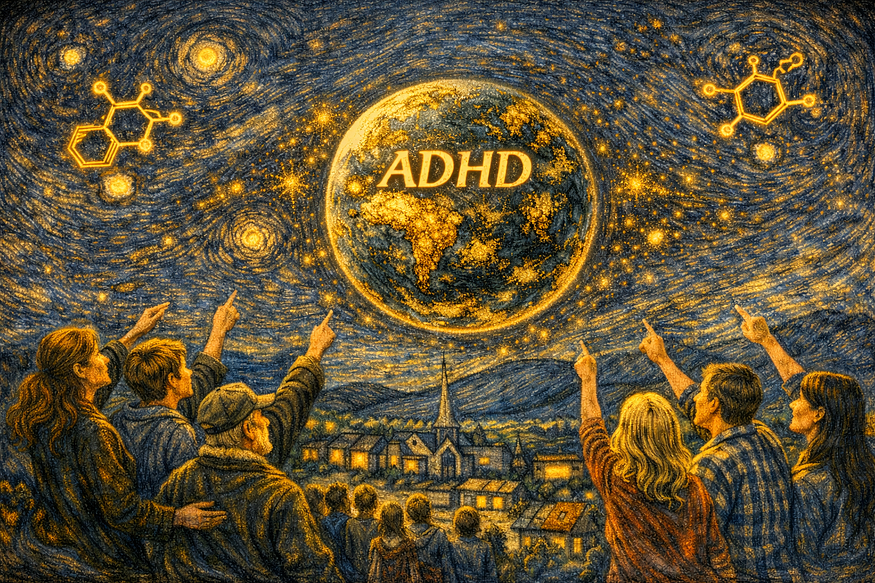
What we now call the ADHD–hypermobility–autonomic–histamine cluster behaves less like a disorder and more like a stable neurobiological variant with deep evolutionary roots. In my clinic the pattern is so consistent — and so therapeutically responsive when approached as a coherent physiology — that I increasingly think of it as a single phenotype that modern environments stretch past its autoregulatory limits.
This phenotype is built for rapid orienting, meaning-first cognition, sensory acuity, flexible energy deployment, and short-burst problem-solving: in evolutionary terms, the hunter mind. Its modern liabilities — orthostatic fragility, language-translation effort, hormonal volatility, histamine sensitivity — are the flip side of those ancestral strengths. Crucially, these liabilities are not separate comorbidities; they are the same architecture under stress. What we have built in the clinic over the years is a small set of interventions that reliably reduce that stress load, widen cognitive bandwidth, and often transfigure functionality. These are not “supplements” or wellness fluff: they are direct responses to identifiable physiological vectors in this phenotype.
Below, I outline how each component of the scaffold emerged — from observation, from patterns across hundreds of patients, from our research into genetic clustering, and from the lived realities of our patients.
1. Magnesium: the jaw, the autonomic brake, and the stimulant paradox
Magnesium became foundational not because of abstract biochemistry but because the same nightly pattern kept appearing: jaw clenching, bruxism, shoulder tension, restlessness, and early-phase sleep fragmentation, especially after stimulant days. Many patients reported benefit from stimulant, but sleep being affected. Magnesium supplements reliably fix this.
In this phenotype, magnesium functions as a smooth muscle relaxant and support for autonomic tone. It softens the TMJ load, reduces nocturnal sympathetic spill, and prevents the “wired-tired” state that amplifies stimulant side-effects. Some need only an evening dose; others — especially those with RLS, chronic jaw tension or extreme sensory load — benefit from 3–4 divided doses per day. It is titrated by function rather than feeling, because interoception in this group is notoriously unreliable. Cheap forms (oxide, citrate) work perfectly well. Read’s second law applies here; “supplement “wisdom” and advice to buy expensive formats is motivated nonsense until proved otherwise” principle applies.
Over time it became obvious: patients were tolerating their stimulants far better with a magnesium “anchor” in place. The only emails I get now describing sleep problems with stimulant are from the patients who have ignored the magnesium advice. Problem solved.
2. Histamine: a genetic signal that shows up clinically long before it shows up biochemically
Our genetic mapping keeps showing the same thing: enriched variants in HNMT, DAO, ABP1, and mast-cell-linked cytokine pathways; FUT2 non-secretor alleles; FLG barrier variants; IL-4/IL-13 leaning. But the more compelling evidence comes from the clinic. Patients report some, any or all of overheating, flushing, rashes, idiopathic itching, upper-GI volatility, bladder urgency, air-hunger episodes, migraine escalation, and unprovoked anxiety spikes — all of which respond disproportionately well to H1/H2 blockade.
Histamine in this phenotype behaves like an alarm system rather than a simple mediator: the body’s signal that the system is overloaded, under-buffered, or both. For many patients, the nocturnal existential audit — “reviewing their entire life between midnight and 2am” — is not a cognitive phenomenon but a mast-cell one.
We do not usually need expensive or difficult mast-cell testing to begin treatment. In practice, a pragmatic antihistamine trial is often more informative and more useful.
Fexofenadine (H1) every morning, increased to BD if needed, and famotidine (H2) at night reliably dampen this alarm (and are much better for the microbiome than long term omeprazole). The combination stabilises sleep, reduces postural volatility, and markedly widens the language-processing window. It also eliminates another tranche of “side effects” of treatment. This is not allergy treatment; it is neuroautonomic hygiene in a phenotype primed for high histamine tone.
3. Fluid, electrolytes and compression: the hypermobile autonomic base
Hypermobility is the skeleton on which the rest of this phenotype hangs. In connective-tissue-light bodies, venous return is poor, blood pools in the limbs, and brainstem perfusion fluctuates. The result is the familiar triad: morning fog, task-inertia, and postural irritability.
Electrolyte-rich hydration (not plain water), daily use of oral electrolytes, and compression wear (calf, thigh or shorts) are not optional add-ons: they are the mechanical corrections that make the stimulant “fit” work predictably. Patients who think they “don’t need it” are usually the same patients whose interoception is least trustworthy. When they run the scaffold anyway, their stamina improves, sensory load falls and the stimulant stops behaving erratically.
These measures are familiar from connective-tissue and autonomic medicine; Planet ADHD simply treats them as baseline physiology. In practice, they often help even our non-hypermobile patients
4. Micronised Utrogestan (bio-identical): the calming neurosteroid anchor that benefits so many ADHD women
Cycle-related and hormonal difficulties are extremely common in ADHD/ASD women. We see perimenopausal shifts beginning around 37–38 — sometimes earlier. Reduced interoception and alexithymia mean many under-report or cannot clearly describe their cycles, yet functional impact is severe. Blood hormone levels fluctuate daily and rarely correspond to symptoms, so tests and scans often delay care while adding little value. A pragmatic, symptom-led protocol is more humane, safe, and effective. Each step uses established, reversible treatments with low risk, rapid feedback, and high potential for improvement.
Micronised progesterone (utrogestan) at 100 mg nocte is consistently transformative. It deepens sleep, steadies adrenergic tone, reduces histamine reactivity, softens sensory edges, stabilises the cycle and improves stamina. In many cases it is the missing neurosteroid buffer that supports function and sleep, and allows the stimulant to work as intended.
5. Metformin: the metabolic axis of the hunter phenotype
Our genetic study keeps returning the same pattern: MDR1, HNF4A, MTNR1B, PPARG and other insulin-resistance-leaning variants enriched in this phenotype. Clinically the same signal appears again and again, including in lean women: PCOS-spectrum features, carbohydrate cravings, post-stress crashes, volatile energy, stretch marks and a lifelong effort to keep weight stable. Many patients describe the same internal experience — a sense that their metabolism is slightly unstable, that energy and appetite swing more than they should.
This clinical picture aligns with emerging epidemiological research. Large meta-analyses now suggest that people with ADHD have roughly double the risk of developing type 2 diabetes compared with the general population (adjusted estimates around OR ≈ 2.3).
What is striking, however, is how this finding is interpreted. When other high-risk populations — for example people of South Asian or African ancestry — show elevated rates of type 2 diabetes, the discussion focuses on biology: genetic architecture, insulin signalling, adipocyte function, endocrine regulation and environmental mismatch. Behavioural blame is rarely the central explanation.
In ADHD, the tone often shifts. The same papers that report the increased metabolic risk frequently speculate about “poor lifestyle choices,” impulsive eating, or even stimulant medication as causal explanations. On Planet Earth it is always open season for ADHD.
Scientifically this makes little sense. The symptoms often cited as evidence of behavioural dyscontrol — food cravings, carbohydrate crashes, fatigue, brain fog — are the classic manifestations of metabolic instability in any population. They are physiological signals, not character flaws. When insulin signalling is unstable the brain asks for fuel. When glycaemic swings occur the result is fatigue and cognitive fog. ADHD does not suspend the laws of endocrinology.
In clinical practice the physiology behaves exactly as expected. When the metabolic axis is stabilised, the symptoms often settle. Metformin frequently has a disproportionate effect in this phenotype: appetite becomes calmer, energy steadier, and the characteristic “brain fog” improves. This is the same pharmacology that helps any insulin-resistant state.
Metformin functions here as a metabolic stabiliser rather than simply a diabetes drug. It improves hepatic signalling, supports insulin sensitivity, quiets inflammatory tone, moderates histamine load and often narrows the amplitude of hormonal volatility in women. How much better to add stimulants to a stabilised physiology than expect them to mask metabolic symptoms as well as support language processing. I increasingly think metformin deserves consideration within ADHD care where the metabolic phenotype is present, rather than being treated as a separate issue.
6. Creatine: patient-driven, clinically validated
Creatine supplements entered the scaffold because patients kept reporting that it helped: clearer thinking; more reliable mood; less afternoon crash; an easier morning transition into task. Once we started noticing the pattern, it became obvious that the energy-hungry, language-translation brain of this phenotype benefits from a small buffer. It is inexpensive, safe, and widely used in neurology and patients can continue if helpful.
7. Stimulants: the language-processing update, not the personality change
Stimulant is at the centre of Planet ADHD, but works best when introduced into a stabilised system. It is the final layer — the software update that fixes the linear language processing bottleneck, and best tolerated when the underlying physiology is stable.
This phenotype does not mainly struggle with attention. It struggles with language translation. It is meaning-first, image-first, conceptual-first, and must convert linear language into something usable. That conversion is effortful, fatiguing and brittle. Stimulants widen the auditory window, sharpen lexical access, and make reading/writing/meeting participation possible.
But when autonomic load is high, histamine is firing, sleep is thin, or hormonal buffering is low, stimulants become unpredictable. Patients will respond far better to one type of stimulant than the other, so it is important to get the right one. Some patients do better with short acting stimulant. With the scaffold in place, it is far easier to stabilise the regime.
8. Interoception and the reason we treat first, feel later
A large proportion of our patients are alexithymic at the interoceptive level: not emotionally detached, but unable to register internal physiological signals until they reach crisis stage. This is why many dismiss interventions that demonstrably help; they can’t feel the benefit early or clearly.
On Planet ADHD we treat according to phenotype, not according to perceived need. We assume the scaffold is needed, because the body signals are unreliable. Over time, interoception improves: the system learns to recognise quiet as safety, not emptiness.
Conclusion: a coherent adaptive physiology, not a bag of comorbidities
The Planet ADHD scaffold is not eclectic. It emerged from the same pattern repeating across hundreds of cases:
• sensory overload
• volatile autonomic tone
• fragile sleep architecture
• under-buffered neurosteroid layers
• high histamine tone
• insulin-leaning metabolism
• language-translation bottlenecks
• poor interoception
• connective-tissue physiology
This is a single phenotype under modern environmental strain. Every component of the scaffold targets a predictable fault line. When we stabilise the base — histamine, sleep, autonomic tone, hormones, metabolic signalling — the stimulant can do what it was meant to do: not create focus, but release fluency.
Planet ADHD is simply the world in which this physiology is understood.
Resources
- Garcia-Argibay M, et al. (2023). Association between attention-deficit/hyperactivity disorder and type 2 diabetes: a systematic review and meta-analysis. Neuroscience & Biobehavioral Reviews.
- Ai Y, et al. (2022). The relationship between diabetes mellitus and attention-deficit/hyperactivity disorder: a systematic review and meta-analysis.