
Didn’t know or didn’t want to know?
When “kindness” is the cruellest response It has become a predictable ritual in contemporary intellectual life that any claim of recent human evolution, or population-level behavioural differentiation, is met with a swift denunciation. Few examples illustrate this reflex better than the reception of Cochran and Harpending’s The 10,000 Year Explosion. The book may be imperfect and […]
Planet ADHD: A Phenotype-Specific Scaffold for the Hunter Mind
What we now call the ADHD–hypermobility–autonomic–histamine cluster behaves less like a disorder and more like a stable neurobiological variant with deep evolutionary roots. In my clinic the pattern is so consistent — and so therapeutically responsive when approached as a coherent physiology — that I increasingly think of it as a single phenotype that modern environments stretch […]
Why do 5% of humans have ADHD?
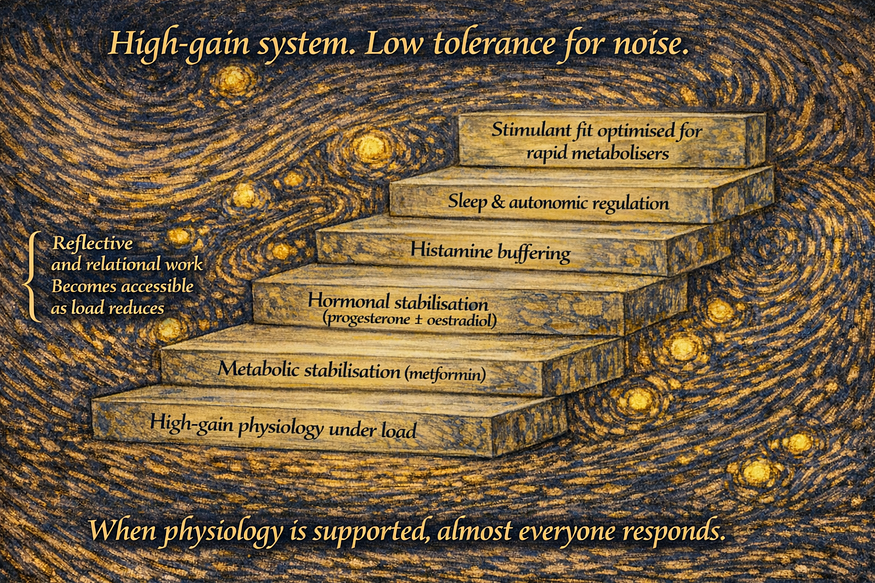
Attention Deficit Hyperactivity Disorder (ADHD) is conventionally conceptualised as a neurodevelopmental disorder of attention and executive control. However, in adult clinical populations — ADHD does not travel alone. Instead, it is repeatedly embedded within a broader pattern that includes sensory overload, autonomic lability, hormonal sensitivity (women), connective-tissue-leaning features, immune and histamine reactivity, metabolic vulnerability, increased […]
P-hacking, Phenotypic Ambiguity, and the Limits of Statistical Inference in Psychiatry: Implications for ADHD Research
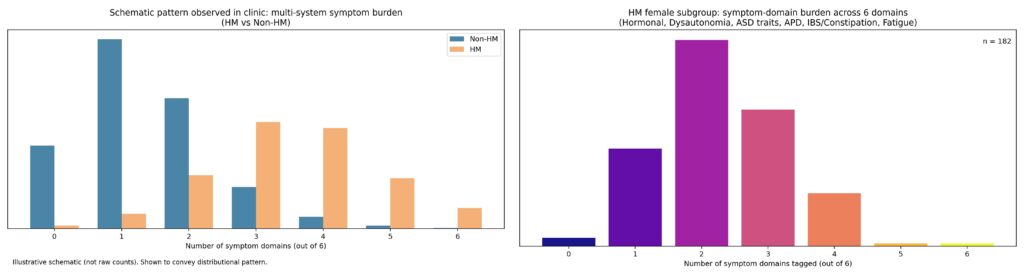
And why my research is ground-breaking but not publishable P-hacking - defined as undisclosed analytic flexibility that inflates false-positive findings - has been widely discussed as a contributor to the replication crisis across the behavioural sciences. While often distinguished from outright scientific fraud on the basis of intent, p-hacking produces equivalent epistemic damage by introducing untrustworthy findings into the […]
The Fast Brain in a Slow World: ADHD, Evolution, and the Return of Clinical Anthropology

What if ADHD isn’t a disorder at all, but an evolutionary adaptation? This article explores how recent human evolution may explain ADHD traits — and why understanding this could change how we diagnose and support neurodivergent people.